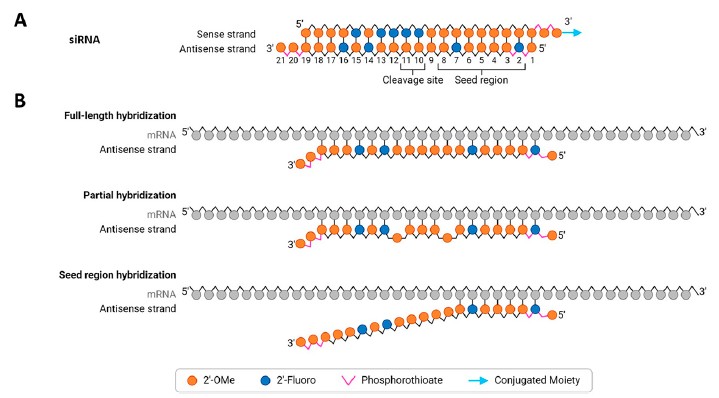
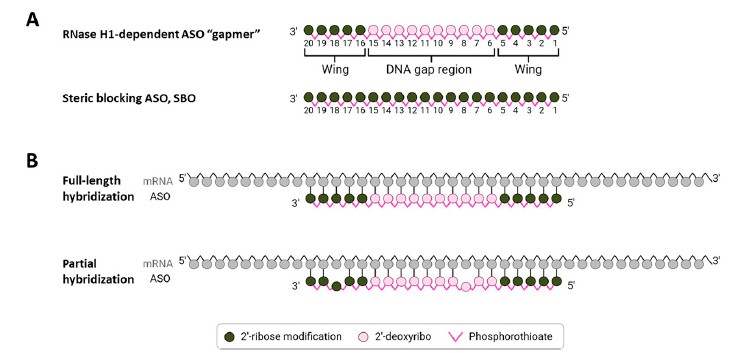
Oligonucleotide therapeutics, including antisense oligonucleotides (ASOs) and small interfering RNAs (siRNAs), act through base pairing between a short sequence and a target transcript. Although sequences can be selected that perfectly match only the intended target, partial complementarity to other transcripts can cause off-target effects (Figure 1). These hybridization-dependent off-target effects have been well established for siRNA and ASO therapeutics as a frequent cause of confounding results in early studies and toxicity in later development [4, 6, 7].
To address these risks, off-target assessment has become a defined expectation for oligonucleotide programs. Updated industry recommendations from the Oligonucleotide Safety Working Group set out a structured framework for identifying and assessing hybridization-dependent off-targets [1], and the current FDA draft guidance recommends that sequence-dependent off-target assessment be conducted using both in silico and in vitro methods [2]. This article summarizes the rationale for early assessment of off-target activity, how in silico prediction and RNA-seq studies are used together, and what assessment options are available at Synoligo.
The rationale for early assessment
Several practical considerations support assessing off-target activity early.
- Data interpretation: A phenotype observed in a knockdown experiment may reflect off-target silencing rather than loss of the intended target. Assessing off-targets, and confirming results with an independent sequence directed at the same target, protects the validity of the conclusions [1].
- Safety: Off-target, hybridization-dependent activity is a recognized contributor to oligonucleotide toxicity, including gapmer hepatotoxicity and seed-driven siRNA liver findings. Identifying higher-risk candidates before in-life studies reduces late-stage attrition and animal use [4, 7].
- Regulatory support: A documented, reproducible off-target evaluation supports the specificity assessment expected as a program advances toward the clinic, consistent with current industry recommendations and draft regulatory guidance [1, 2].
Early assessment also lowers overall cost. Resolving a specificity liability before in-life studies is far less expensive than discovering it afterward.
Prediction and confirmation: two methods that work together
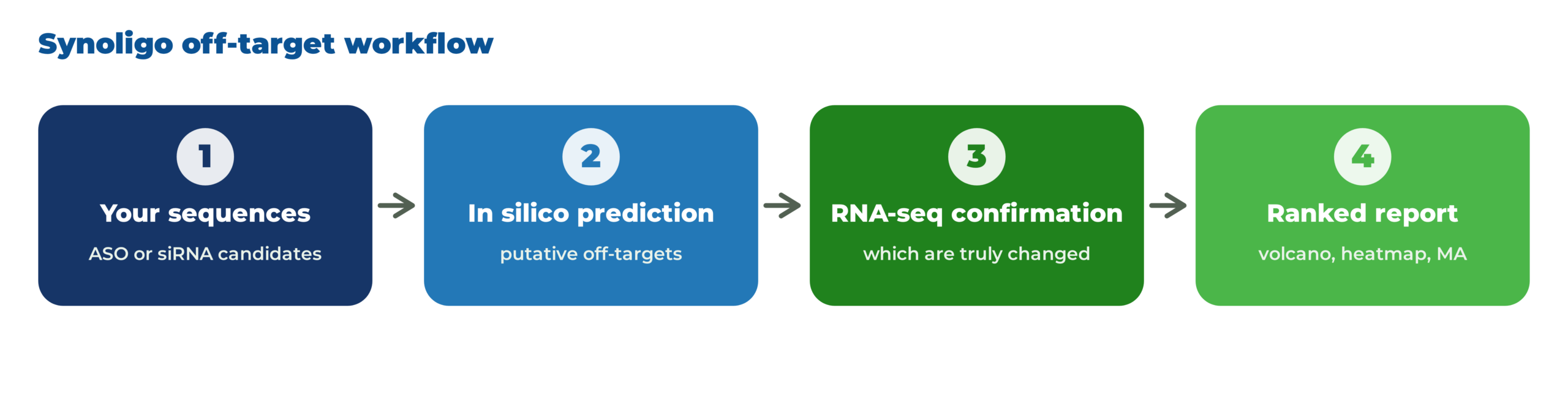
Because hybridization-dependent effects are encoded in sequence, in silico off-target prediction is a valuable first step. Each candidate is compared against comprehensive transcript reference databases, allowing for mismatches and wobble pairing, with weighting to account for the impact of mismatches at different positions in the ASO or siRNA guide strand. This analysis is effective at defining the universe of putative off-targets and at steering design away from sequences with high similarity to unintended transcripts [1, 5].
However, current in silico prediction also has a well-documented limitation: it defines which off-targets are possible, but cannot reliably predict which of them will actually be affected. In fact, the majority of predicted off-targets show no change when tested experimentally [1, 3]. Unbiased experimental methods are therefore required to confirm selectivity. RNA-seq measures the whole expression response without prior assumptions and identifies off-targets that are genuinely modulated. Both the industry recommendations and the FDA draft guidance treat in silico prediction and experimental methods such as RNA-seq as complementary parts of a single assessment [2, 3, 9, 10]. The two are strongest when used together to maximize selectivity: prediction narrows and prioritizes, and RNA-seq confirms.
Assessment options at Synoligo
Synoligo provides off-target assessment at two levels, which can be combined for the most complete picture.
Off-target prediction for sequence prioritization: Candidate sequences provided by the client are analyzed in-house to predict off-target binding across the transcriptome, prioritizing sequences based on off-target potential. Because in silico prediction alone cannot establish which off-targets are real, this option is designed to be paired with RNA-seq confirmation, so that predicted sites are verified experimentally [1, 2, 3].
Selectivity analysis by RNA-seq: This in vitro method provides an unbiased, transcriptome-wide measurement of the expression changes produced by a candidate oligonucleotide. Because RNA-seq captures the full expression response in a single dataset, intended knockdown and unintended off-target changes are observed together [3, 9, 10].
The off-target report
Both options are delivered as a data report that summarizes the transcriptome-wide effects of each candidate beyond its intended target. Three views convey most of the relevant information.
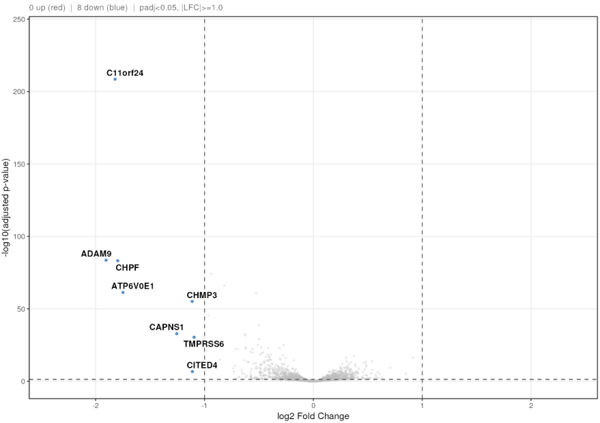
- Volcano plot: This plot relates the magnitude of change (log₂ fold change) to statistical significance for each transcript, so that significantly up- or down-regulated genes are readily identified.
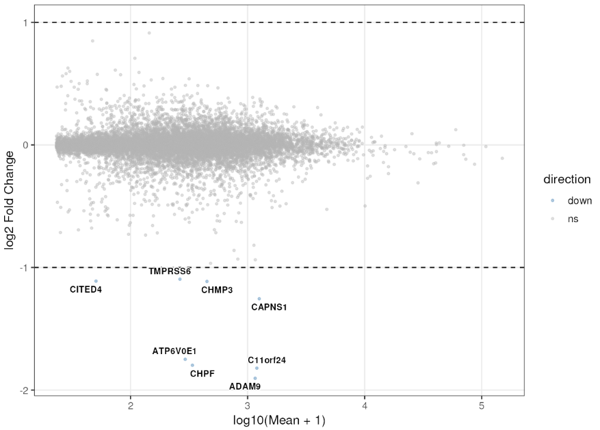
- Manhattan (MA) plot: This plot relates the average expression of each transcript to its change between conditions, which helps separate reproducible off-target changes from low-count noise.
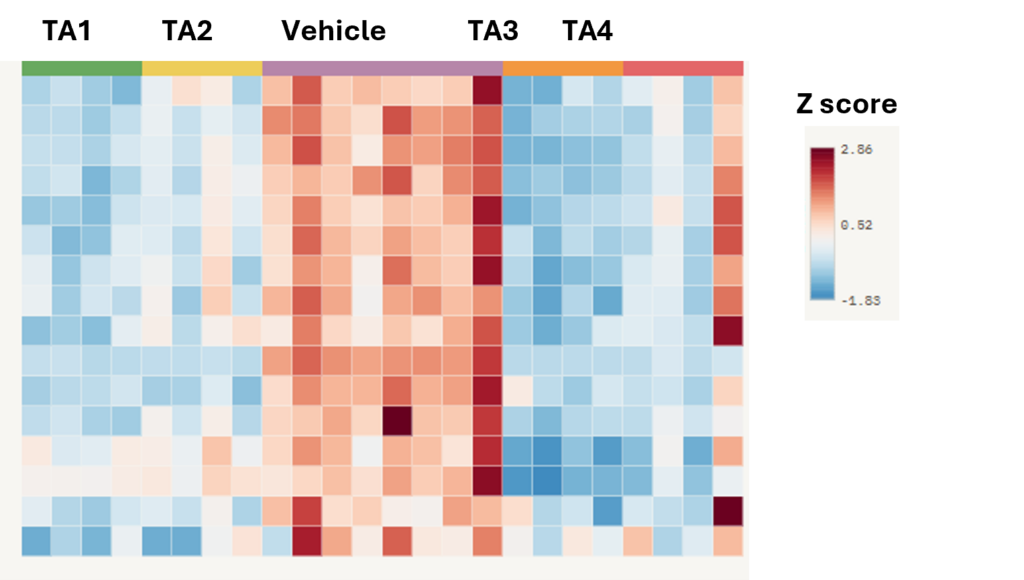
- Heatmap: This plot displays expression across many transcripts and several treatments or doses at once and clusters similar patterns, indicating the breadth and consistency of off-target activity.
The figure below shows a representative Synoligo off-target analysis. Using a highly selective siRNA and a less selective siRNA identified by Subramanian and colleagues [14], the Synoligo RNA-seq workflow reproduced the off-target signatures reported in that study.
Volcano Plot
Manhattan (MA) Plot
Heatmap Plot
From assessment to candidate selection
Off-target activity is an expected property of oligonucleotides rather than a rare exception, and it is most informative when assessed during design rather than at the end of a program. Specificity should be evaluated across a panel of candidates, candidates that combine strong on-target activity with low off-target activity should be prioritized, and the highest-ranked off-target sites should be confirmed before committing to in-life studies. Whether a program begins with an RNA-seq measurement or with sequence-based prediction, the objective is the same: to support data interpretation, reduce late-stage attrition, and demonstrate candidate specificity.
For a discussion of which option is most appropriate for a given program, email us at biologysales@synoligo.com.
References
- Andersson P, Burel SA, Estrella H, et al. Assessing hybridization-dependent off-target risk for therapeutic oligonucleotides: updated industry recommendations. Nucleic Acid Ther. 2025;35:16-33. doi:10.1089/nat.2024.0072
- US Food and Drug Administration, Center for Drug Evaluation and Research. Nonclinical Safety Assessment of Oligonucleotide-Based Therapeutics: Guidance for Industry (draft guidance). November 2024. Available from FDA
- Damle SS, Watt A, Kuntz S, et al. A workflow for transcriptome-wide assessment of antisense oligonucleotide selectivity. Nucleic Acid Ther. 2025. doi:10.1177/21593337251378141
- Burel SA, Hart CE, Cauntay P, et al. Hepatotoxicity of high affinity gapmer antisense oligonucleotides is mediated by RNase H1-dependent promiscuous reduction of very long pre-mRNA transcripts. Nucleic Acids Res. 2016;44:2093-2109. doi:10.1093/nar/gkv1210
- Kamola PJ, Kitson JDA, Turner G, et al. In silico and in vitro evaluation of exonic and intronic off-target effects form a critical element of therapeutic ASO gapmer optimization. Nucleic Acids Res. 2015;43:8638-8650.
- Jackson AL, Linsley PS. Recognizing and avoiding siRNA off-target effects for target identification and therapeutic application. Nat Rev Drug Discov. 2010;9:57-67. doi:10.1038/nrd3010
- Janas MM, Schlegel MK, Harbison CE, et al. Selection of GalNAc-conjugated siRNAs with limited off-target-driven rat hepatotoxicity. Nat Commun. 2018;9:723. doi:10.1038/s41467-018-02989-4
- Birmingham A, Anderson EM, Reynolds A, et al. 3′ UTR seed matches, but not overall identity, are associated with RNAi off-targets. Nat Methods. 2006;3:199-204.
- Yoshida T, Naito Y, Yasuhara H, et al. Evaluation of off-target effects of gapmer antisense oligonucleotides using human cells. Genes Cells. 2019;24:827-835. doi:10.1111/gtc.12730
- Michel S, Schirduan K, Shen Y, et al. Using RNA-seq to assess off-target effects of antisense oligonucleotides in human cell lines. Mol Diagn Ther. 2021;25:77-85. doi:10.1007/s40291-020-00504-4
- Hagedorn PH, Hansen BR, Koch T, et al. Managing the sequence-specificity of antisense oligonucleotides in drug discovery. Nucleic Acids Res. 2017;45:2262-2282. doi:10.1093/nar/gkx056
- Dieckmann A, Hagedorn PH, Burki Y, et al. A sensitive in vitro approach to assess the hybridization-dependent toxic potential of high affinity gapmer oligonucleotides. Mol Ther Nucleic Acids. 2018;10:45-54.
- Lindow M, Vornlocher H-P, Riley D, et al. Assessing unintended hybridization-induced biological effects of oligonucleotides. Nat Biotechnol. 2012;30:920-923.
- Subramanian S, et al. Nat Commun. 2023;14. [full author list and title to be confirmed] doi:10.1038/s41467-023-37774-5